
Waymark Gardens
Qualitative research | Data analysis | Synthesize research findings | Ideation & Service design
This is a real-world design research project. Our research client was Waymark Gardens, which serves low-income older adults (60+) who maintain an independent living status with or without assistance. The topic my team was assigned was food/grocery delivery. Through observation, interview, and analysis, I understood residents' experience of food/grocery purchase and delivery and finally generated and evaluated some potential solutions to improve their experience.
Timeline:
3 months
Role:
Design research, observation, interview, data analysis, generate ideas
Team:
Qijia You, Sabrina Medrano, Ashley Lucas
Tools:
Zoom, Miro, Note-taking, Adobe After Effects, Photoshop
The challenge.
• Uncover Waymark Gardens residents' core inconveniences and
• concerns about food/grocery purchase and delivery experience.
• Generate some potential solutions to improve residents' experiences of food/grocery purchase and delivery.
• Generate interviews to evaluate my draft ideas.
Process.
OBSERVATION
Research plan.

Photo records.


Raw data & notes.


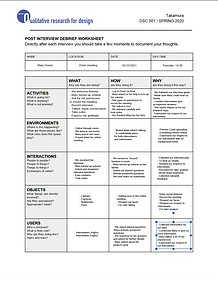
Observation debriefs forms.
We observed the community at three different times:
• Late morning/noon(11:00am-1:00pm),
• Afternoon(2:00pm-3:30pm),
• Evening(5:30pm-6:00pm)


OBSERVATION ANALYSIS
5 Whys...


Data coding.
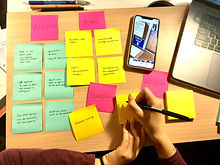
• First-level coding: according to time, we coded our data based on what we observed at different times of the day. We used the idea of A(x4) to classify them as actors, activities, artifacts, and atmospheres.
• Pattern codes: In this step, we explored our data and clustered them within different themes, such as the component of the community, things related to food and grocery, the impact of Covid-19, etc.



Takeaway.
• When observing the location and surrounding areas, we noticed there was a lack of fast food and
grocery stores that were within a reasonable distance from Waymark Gardens.
• Covid-19 precautions have not allowed residents to use common areas such as kitchens and lounges.
• There are many access points for food delivery throughout the entire community.
• Outside community help from families in the area.
• During the day, a free shuttle bus service is available for residents.
INTERVIEW
Interview plan.
We want to understand residents' experience with food/grocery purchases and delivery. Through interviews, we want to uncover residents' core inconveniences and concerns about that, so we can find out some potential solutions to improve their experience.

Interview guide.


Gut interview.
We select 5-8 questions from my interview guide that everyone could answer, and took 5 minutes to quickly interview 2 of my friends. The goal was to test if some of my interview questions worked.


Interview.
Four main topics/questions we focused on:
• How do they get groceries?
• Are they familiar with online food/grocery order service?
• Do they know how to place order online?
• Are they interested in community events with an emphasis on food?


INTERVIEW ANALYSIS
Raw data & notes.
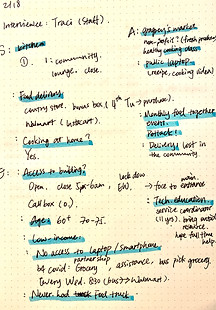


Interview debrief forms.


Interview analysis.
We started to analyze our interviews by transcribing interviews from records to texts. Then we set a color code for the different themes we were looking for. By highlighting interviewees’ key insights with different colors, we were able to uncover relationships we didn’t notice before.


After we color-coded key insights in our interview transcript, we organized information on color stickers and created an affinity map on Miro. The affinity process helped us uncover our interviewees’ pain points and concerns about food/grocery purchases and orders. The outcome of analyzing enabled us to brainstorm some potential opportunities to solve issues they had.


Point of view.

Interview takeaways.
• Residents in Waymark Gardens have various methods to purchase food and groceries, such as order food/groceries
deliveries online, order food/groceries online than pick-up by themselves, and some of their children will get
food/groceries to them.
• 80% of residents of Waymark Gardens do not have a computer or a smartphone. They don't know how to order
food/groceries online.
• Residents who familiar with online food/groceries order prefer to pick up their orders by themselves since 1) service
fee and delivery fee are high; 2) concern about food quality and condition during delivery process; 3) concern about
strangers delivering food.
• The Waymark Gardens community already has some service for their residents, such as a country store once a month,
a shuttle bus for a scheduled time, Friday morning coffee time, and some group activities.
• Residents here are interested in some food-related events such as potluck, food truck and cooking classes, and also
some classes can teach them how to use the computer.
• Expecting some easier way for older people to order food and groceries.
IDEATE
Opportunities.
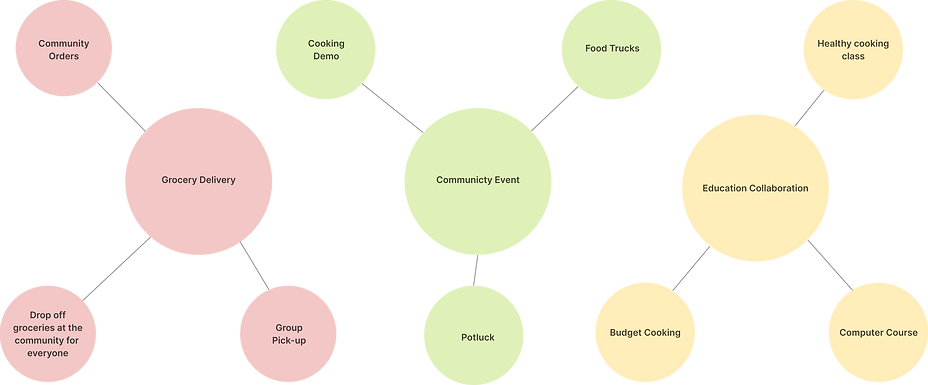
How Might We...
• How might we group order food/groceries for the residents and pick them up for them?
• How might we collaborate with the Adult Education group for more ideas about educating phone and computer use?
• How might we enhance grocery delivery security for the residents at Waymark?
• How might we bring the Waymark community together for events?
• How might we introduce some food trucks to the community for Waymark residents?
Ideation.

Selected ideas.


EVALUATIVE INTERVIEW
Interview plan.
Evaluative interviews explored how well I have framed and solved the specific problem I focused on by asking potential users for feedback. I will use the information and data I collected to identify how to frame the problem better and improve my ideas and proposed solutions.

Survey questions.


Interview.
Traci (Community staff)
Preferred idea: a multi-functional device for residents to submit grocery lists.
Likes:
• Benefit those who don't have a computer or a smartphone;
• Easy to understand and use.
Concerns:
• How to collect payments?
• Need budget and time to pick up groceries for residents.

Mary (Resident)
Preferred idea: having some food trucks come to the community once a month.
Likes:
• Don't need to prepare food by myself;
• Expect different type of food.
Concerns:
• When will it come? lunch time or dinner time?
• Don't want to spend too much for it.

Dave (Resident)
Preferred idea: a multi-functional device for residents to submit grocery lists.
Likes:
• No smartphone or computer, so want to try this;
• Group delivery might be great.
Concerns:
• Need to schedule a time to use it?
• Staff might have no time to pick up for us;
• Safe to enter my personal information on it?

Brenda (Resident)
Preferred idea: having some food trucks come to the community once a month.
Likes:
• I don't like cook!
• It sounds like an event I will participate a lot.
Concerns:
• Want to have variety of foods;
• The price of the food might exceed my budget.

Linda (Resident)
Preferred idea: Taking a class that will teach some basic knowledge of new techs.
Likes:
• I have a smartphone to use;
• I want to learn how to use my smartphone efficiently.
Concerns:
• I want to learn some computer skills, but I don't
have one;
• Who will come to teach us?

Interview analysis

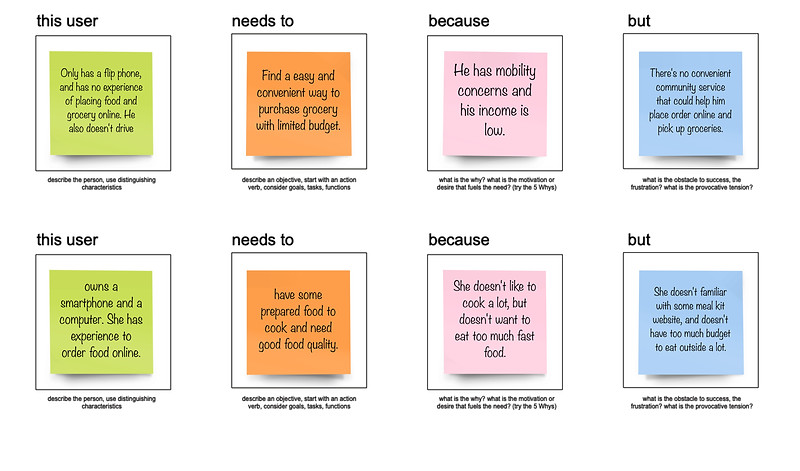
Identify users' needs

Prototype
Refine idea.

Mockups.


Summarize
Final project presentation.
Reflect
Takeaways.
Through this project, I understood the value and application of qualitative research methods and
learned how to plan and prepare for a research study. Through data collection and analysis, I was able to synthesize and translate my finding into actionable insights.
